The Truth About Salt-Free Water Softeners: Pros and Cons
Unlock the Truth About Salt-Free Water Softeners
- Discover the pros and cons of salt-free water softener systems.
- Learn how salt-free softeners work and their effectiveness.
- Understand if a salt-free system is the right choice for your home.
- Explore the environmental impact and cost-effectiveness of salt-free options.
- Compare salt-free softeners to traditional salt-based systems.
 When it comes to improving water quality at home, one of the most debated topics is whether salt-free water softeners are worth the investment. For decades, traditional salt-based water softeners dominated the market, and they’re still widely used. But in recent years, salt-free alternatives have grown in popularity, marketed as eco-friendly, low-maintenance, and a healthier choice for families.
However, there’s a lot of confusion surrounding how they actually work. Some homeowners believe salt-free systems are simply better versions of salt-based ones, while others worry they don’t really “soften” water at all. If you’ve been wondering about the truth behind salt-free water softeners, their pros and cons, and whether they fit your household needs, this guide will break it down in simple, straightforward terms.
We’ll look at how these systems function, their advantages, their drawbacks, and whether they’re the right choice for you.
How Salt-Free Water Softeners Work
To understand the real differences, let’s start with how traditional softeners work. Salt-based water softeners remove hardness minerals—mainly calcium and magnesium—through a process called ion exchange. In short, they swap the hardness minerals for sodium (or sometimes potassium), leaving behind soft water that prevents scale buildup.
Salt-free systems, on the other hand, don’t actually remove hardness minerals. Instead, most rely on a process called Template Assisted Crystallization (TAC). In TAC, special media inside the system changes the structure of the calcium and magnesium ions so they don’t stick to surfaces like pipes, faucets, or appliances.
This means:
- The minerals are still in the water, but they’re neutralized.
- You won’t see the same kind of scale buildup, but your water technically isn’t “soft.”
- There’s no brine discharge, no need to add bags of salt, and much less maintenance.
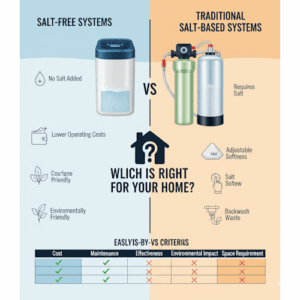
Here’s a quick comparison to highlight the main differences:
| Feature | Salt-Based Softeners | Salt-Free Softeners |
| Process | Removes hardness minerals (ion exchange) | Conditions minerals (TAC or other methods) |
| Water Result | Soft water | Conditioned water (not technically soft) |
| Maintenance | Regular salt refills and cleaning | Minimal maintenance |
| Environmental Impact | Produces brine waste | Eco-friendly, no discharge |
| Cost | Medium upfront + ongoing salt cost | Higher upfront, lower ongoing cost |
So, while both systems deal with hard water, they do so in completely different ways. Salt-free units should be thought of as water conditioners rather than softeners in the traditional sense.
The Pros of Salt-Free Water Softeners
For many households, salt-free water conditioners offer clear benefits that make them appealing. Here are the top advantages you should know:
Low Maintenance
One of the biggest selling points is convenience. Unlike salt-based softeners, you won’t be hauling 40-pound salt bags into your basement or garage every month. The media inside a salt-free system can last years before replacement is needed.
Eco-Friendly Option
Since there’s no salt brine discharged into the environment, these systems are often chosen in areas where traditional softeners are restricted due to wastewater regulations. They also waste far less water during their operation.
Keeps Healthy Minerals in Water
Calcium and magnesium may cause hard water issues, but they’re also essential minerals for health. Because salt-free systems don’t remove them, your drinking water retains its natural mineral balance. Some people prefer this since the water tastes more natural.
Longer Appliance Lifespan
Even though the minerals remain, their crystallized form won’t cling to pipes and heating elements. This helps protect dishwashers, water heaters, and washing machines from scale damage, improving efficiency and extending their lifespan.
No Slippery Feel
Anyone who has used a salt-based softener knows the “slippery” or “silky” feel it leaves on skin after showering. With salt-free systems, that doesn’t happen since minerals are not removed, only conditioned. Many people prefer this more natural feel.
Lower Operating Costs Over Time
Although the upfront cost can be higher, the fact that you’re not constantly buying salt, dealing with high water waste, or performing frequent maintenance means you may save more in the long run.
In short: Salt-free systems provide a convenient, environmentally conscious, and health-friendly way to tackle the problems caused by hard water without the hassle of traditional softeners.
The Cons of Salt-Free Water Softeners
While salt-free water conditioners have benefits, they’re not perfect for every household. Before you invest in one, it’s important to consider the downsides:
They Don’t Truly Soften Water
This is the number one drawback. Because they don’t actually remove hardness minerals, water isn’t technically softened. If you’re expecting that slippery-skin feeling or completely scale-free showers, you may be disappointed.
Limited Effectiveness with Extremely Hard Water
In areas with very hard water (over 25 grains per gallon), salt-free systems may not perform as effectively. Scale prevention is reduced, and you may still notice buildup over time. In such cases, a salt-based system is often the better solution.
Higher Initial Cost
Salt-free conditioners typically cost more upfront compared to standard softeners. While they save on maintenance costs in the long run, the initial investment can be a barrier for some homeowners.
Won’t Remove Existing Scale
Another key drawback is that they won’t eliminate scale already present in your plumbing system. Salt-based softeners can slowly help reduce existing buildup, but salt-free units only prevent new deposits from forming.
May Not Work Well for Large Families
Since they don’t reduce mineral content, households with high water consumption and very hard water may feel less of an impact from a salt-free unit. The conditioning process can be less noticeable when water demand is very high.
Here’s a quick breakdown of these limitations:
| Drawback | Impact |
| Not true softening | Minerals remain in water |
| Limited in very hard water | Less effective beyond 25 gpg hardness |
| High upfront price | May cost more than salt-based initially |
| Doesn’t remove old scale | Only prevents new buildup |
| Less effective for heavy use | High demand households may notice less benefit |
In short: Salt-free systems are excellent for scale prevention, but if you want completely softened water or have extremely hard water, they may not meet expectations.
Choosing the Right Option for Your Home
Deciding between a salt-free and a salt-based water softener depends on your household’s unique needs, water quality, and lifestyle. Here are some key factors to help guide your decision:
Consider Your Water Hardness Level
- If your water is moderately hard, a salt-free system can work well for prevention.
- If your water is extremely hard, a traditional salt-based softener may be necessary.
Think About Maintenance
- Don’t want the hassle of refilling salt and dealing with messy brine? Go salt-free.
- Don’t mind regular upkeep for guaranteed soft water? A salt-based option works.
Check Local Regulations
- In some regions, salt-based softeners are restricted due to brine discharge. In that case, salt-free may be your only choice.
Factor in Health Preferences
- If you want water that retains beneficial minerals, a salt-free unit is better.
- If you prefer the feel and cleaning benefits of softened water, salt-based wins.
Budget Considerations
- Salt-free: higher upfront but fewer ongoing costs.
- Salt-based: lower upfront but recurring expenses for salt and maintenance.
Here’s a side-by-side summary to help you decide:
| Factor | Salt-Based | Salt-Free |
| Best for hardness levels | Very high hardness | Moderate hardness |
| Maintenance | Regular salt refills | Minimal |
| Environmental impact | Brine discharge | Eco-friendly |
| Health/minerals | Removes calcium & magnesium | Keeps minerals |
| Upfront cost | Lower | Higher |
| Long-term cost | Higher | Lower |
Practical Example:
- A small household in a city with moderate hardness and environmental restrictions might find a salt-free system the perfect fit.
- A large rural family with extremely hard water might need a traditional salt-based softener to avoid scale problems.
Conclusion
The truth about salt-free water softeners is that they aren’t actually “softeners” in the traditional sense. Instead, they’re water conditioners that prevent scale without removing hardness minerals. This distinction is key to understanding whether they’re right for you.
Pros: They’re low-maintenance, eco-friendly, and retain healthy minerals in drinking water while protecting your appliances.
Cons: They don’t actually soften water, may not perform well in areas with very high hardness, and cost more upfront.
Ultimately, choosing between a salt-free and a salt-based water treatment system depends on your water hardness, lifestyle, budget, and environmental concerns. Both have their place, but they solve the problem of hard water in different ways.
If you’re after convenience, lower environmental impact, and scale prevention without the hassle of salt, then a salt-free system could be the perfect match. But if you need true softened water for extremely hard conditions, a salt-based system remains the most effective solution.
By weighing the pros and cons carefully, you’ll be able to make the best choice for your home, your family, and your long-term comfort.
Recommended Reading
Finding the Best Water Softener for Well Water in 2025: The Ultimate Guide
Unlock the Secret to Pure, Soft Well Water Discover the best water softener for your well, ensuring pristine water quality. Learn how to effectively combat hard water issues and their consequences. Save money and time by choosing the right softener for your needs. Improve the lifespan of your appliances and plumbing system. Enjoy the benefits […]
Water Softener Myths Debunked: What You Really Need to Know
Debunk Water Softener Myths & Transform Your Home Learn the truth about common water softener myths. Discover the real benefits of soft water for your home. Understand which water softener is right for your needs. Save money and improve your water quality. Protect your appliances and plumbing system. When it comes to water softeners, there’s […]
Leave a Reply